
Design and Implementation of a Low-Cost Automated Candy Sorting System Using Arduino and TCS3200 Color Sensor
- Facultad Ingeniería, Universidad Evangélica de El Salvador, San Salvador, El Salvador
Contacto: [email protected]
Conflicto de interés: Sin conflictos
Design and Implementation of a Low-Cost Automated Candy Sorting System Using Arduino and TCS3200 Color Sensor


Background
- The growing demand for automation in industries such as food, textile, and recycling has driven the use of color-based sorting systems, crucial for ensuring efficiency and quality.
- Errors in color matching can lead to product rejection, even if other quality parameters are met. This project develops a small-scale system to sort candies by color, using the TCS3200 sensor, an Arduino Nano, and servomotors.
- The solution is cost-effective, efficient, and applicable in agriculture, food processing, and recycling, where sensors and microcontrollers identify and classify objects by color.
Objective
To develop an automated color-sorting system for candies, capable of completing the separation process within a maximum of 5 seconds, demonstrating real-time efficiency. The system aims to ensure accurate color-based classification at minimal implementation cost, making it ideal for low-volume sorting tasks in resource-limited applications.
Methodology
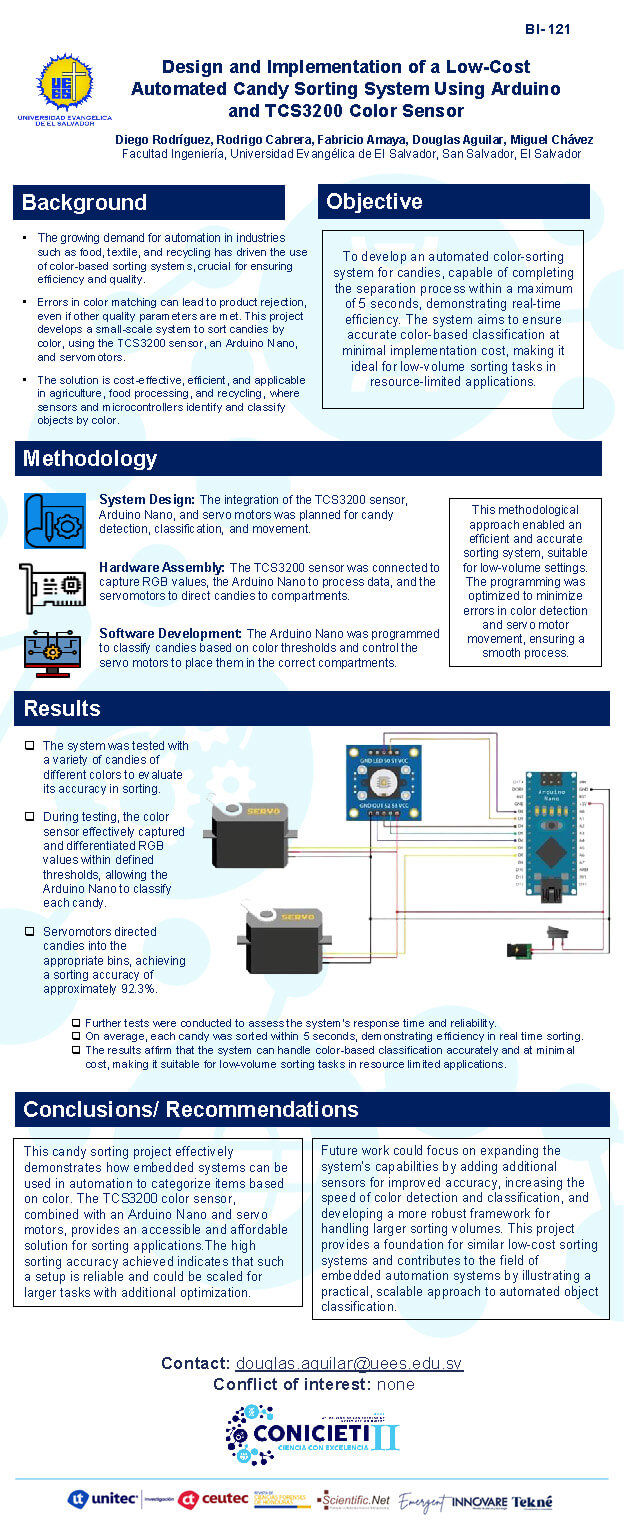
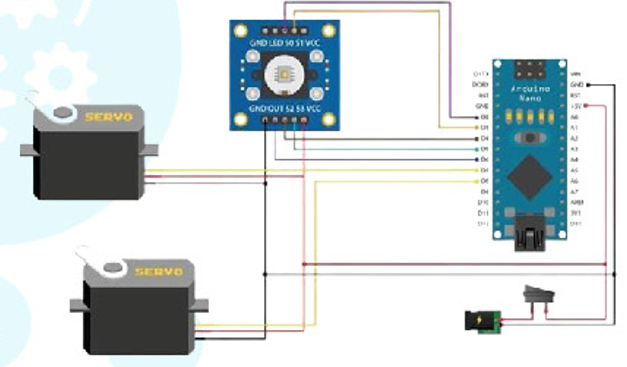
System Design: The integration of the TCS3200 sensor, Arduino Nano, and servo motors was planned for candy detection, classification, and movement.
Hardware Assembly: The TCS3200 sensor was connected to capture RGB values, the Arduino Nano to process data, and the servomotors to direct candies to compartments.
Software Development: The Arduino Nano was programmed to classify candies based on color thresholds and control the servo motors to place them in the correct compartments.
This methodological approach enabled an efficient and accurate sorting system, suitable for low-volume settings. The programming was optimized to minimize errors in color detection and servo motor movement, ensuring a smooth process.
Results
- The system was tested with a variety of candies of different colors to evaluate its accuracy in sorting.
- During testing, the color sensor effectively captured and differentiated RGB values within defined thresholds, allowing the Arduino Nano to classify each candy.
- Servomotors directed candies into the appropriate bins, achieving a sorting accuracy of approximately 92.3%.
- Further tests were conducted to assess the system’s response time and reliability.
- On average, each candy was sorted within 5 seconds, demonstrating efficiency in real time sorting.
- The results affirm that the system can handle color-based classification accurately and at minimal cost, making it suitable for low-volume sorting tasks in resource limited applications.
Conclusions/ Recommendations
This candy sorting project effectively demonstrates how embedded systems can be used in automation to categorize items based on color. The TCS3200 color sensor, combined with an Arduino Nano and servo motors, provides an accessible and affordable solution for sorting applications.The high sorting accuracy achieved indicates that such a setup is reliable and could be scaled for larger tasks with additional optimization.
Future work could focus on expanding the system’s capabilities by adding additional sensors for improved accuracy, increasing the speed of color detection and classification, and developing a more robust framework for handling larger sorting volumes. This project provides a foundation for similar low-cost sorting systems and contributes to the field of embedded automation systems by illustrating a practical, scalable approach to automated object classification.








 EN
EN  ES
ES