
Parametric Optimization of Optical Ring Resonators for Biomedical Biosensing Applications
- 1 Facultad de Ingeniería Mecánica y Eléctrica Unidad Norte, Universidad Autónoma de Coahuila, Monclova México.
- 2 Coordinación para la Innovación y Aplicación de la Ciencia y la Tecnología, Universidad Autónoma de San Luis Potosí, San Luis Potosí, México
Contacto: [email protected]
Conflicto de interés: Sin conflictos
Optimización paramétrica de resonadores de anillo óptico para aplicaciones de biodetección biomédica

Abstract
Biosensors, which emerged in the 1960s, convert biological interactions into measurable signals through a system comprising recognition, transduction, and signal processing elements. Among them, optical biosensors—particularly those based on resonators such as ring resonators—stand out for their high sensitivity and ability to detect small changes in the refractive index. In this work, we designed the structure of the resonator ring, this structure was selected as the most suitable due to its advantageous operational principles, illustrated in Figure 1.
Methodology
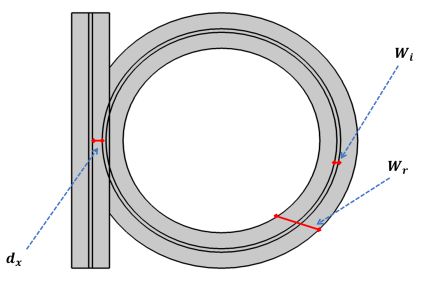
Ring resonator-based optical biosensors were designed and simulated using the software COMSOL to optimize sensitivity, quality factor, and detection limits. Using Silicon and Silicon Dioxide as materials of Cladding and Core, respectively. Key geometric parameters are Radius of curvature (R) : 62 μm
Cladding width (Wr): 2 μm
Core width (Wi): 0.2 μm
Gap (dx): 0.7 μm, with the modeled structure shown in Figure 2.
Results
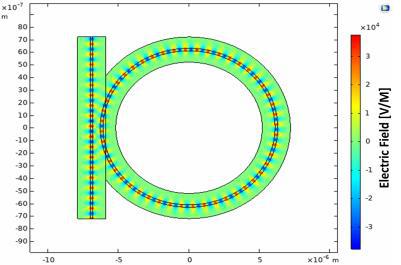
The electric field distribution reveals the resonant modes.
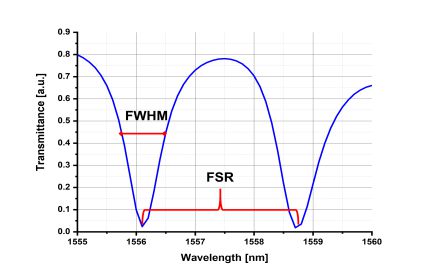
The figure 4 show the optimization of the transmission spectrum of a ring resonator. Obtained values of FWHM: 0.3 nm represents the full width at half maximum of the resonance dip. A FSR of 2.7 nm indicated the free spectral range between consecutive resonances. A High Q-factor of 1.5 × 10⁶
Conclusions
The optimized ring resonator biosensor, built with silicon and silicon dioxide, achieved high Q- factors (~10⁶), demonstrating strong sensitivity and compact design. Its performance is comparable to advanced structures like microdisks and photonic crystals. This makes it a promising candidate for lab-on- chip and clinical sensing applications.









 ES
ES  EN
EN