
MyoWave: EMG Band for Analysis and Feedback in Strength Training Beginners
- Engineering Faculty, Universidad Tecnológica Centroamericana (UNITEC), Tegucigalpa, Honduras
Contacto: [email protected]
Conflicto de interés: Sin conflictos
MyoWave: Banda EMG para análisis y retroalimentación en entrenamiento de fuerza para principiantes


Background
Surface electromyography (EMG) assesses muscle activity, identifying activation, force production, and fatigue processes. Advances in signal processing have improved its accuracy and applicability in a variety of fields. Muscle monitoring also contributes to movement analysis and injury prevention. The development of highly sensitive, portable EMG sensors has facilitated its adoption in both sports and clinical settings.
Objective
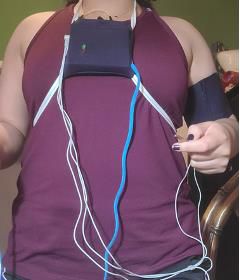
Design a prototype EMG sensory band to measure biceps activation during strength exercises and provide feedback for technique learning and injury prevention in beginners.
Methodology
The research followed a mixed-methods and descriptive approach to design a prototype EMG-based sensory headband, evaluating parameters such as Median Frequency (MDF) and Root Mean Square (RMS). The system included visual feedback and was validated by comparison with previous stidues, demonstrating its usefulness in practical learning and injury prevention.
- Literature Review
- Electromyography Band Design
- Data Collection
- Validation Methodology
Results
Development of an EMG-based sensory band, using an ESP32 microcontroller circuit and EMG sensors, capable of measuring and processing muscle signals in real time. Algorithms were designed to extract: Median Frequency (MDF) and Root Mean Square (RMS). The downward trend in the MDF and the increase in the RMS validated the expected signal behavior under physical exertion.
In addition, a visual feedback system using LEDs was incorporated, linked to EMG signal analysis, which proved useful in alerting to potential risks of fatigue or poor technique. Comparison with previous studies confirmed the effectiveness of the approach and highlighted that an intuitive visual feedback system can facilitate the learning of correct techniques and the prevention of musculoskeletal injuries, reinforcing the role of EMG in safe training environments.
Conclusions/Recommendations
The electromyography-based sensory band prototype proved to be an effective tool for measuring muscle activation and fatigue in real time, thanks to the analysis of parameters such as Median Frequency (MDF) and Root Mean Square (RMS). Furthermore, the integration of a visual feedback system using LEDs facilitated immediate technical correction, motor learning, and injury prevention during strength training.










 ES
ES  EN
EN